Monday, 24 July 2017

Occultation and Transit

Eclipses, Occultations and Transits

An eclipse is the result of the total or partial masking of a celestial body by another along an observer’s line of sight. Solar eclipses result from the Moon blocking the Sun relative to the Earth; thus Earth, Moon and Sun all lie on a line. Lunar eclipses work the same way in a different order: Moon, Earth and Sun all on a line. In this case the Earth’s shadow hides the Moon from view. An occultation occurs when a celestial object is eclipsed by the Moon or another solar system body. A transit is either the act of one celestial body passing in front of another or the time at which a celestial object is highest in the sky. The time at which a celestial object crosses the meridian is called the transit time.

Featured Images

Annular solar eclipse Fiery Ring August 31, 2016
Moon-Aldebaran occultation Vanishing Act July 28, 2016
Mercury transits the Sun, May 2016 Little Black Dot May 10, 2016
2006 transit of Mercury Spotty Sun May 6, 2016
Total lunar eclipse, October 2014 Lunar Eclipse September 26, 2015
Space-based view of solar eclipse of March 20, 2015 Disappearing Sun March 20, 2015
Artist's concept of Epsilon Aurigae Playing Frisbee November 23, 2014
The Moon occults Dabih, a star in Capricornus Celestial Cover-Up September 5, 2014
Peek-a-Boo January 31, 2014
Solar eclipse of August 19, 1887, from near Berlin Fire in the Sky August 18, 2012
June 5, 2012, Venus transit from International Space Station Seeing Spots June 9, 2012
Diagram of Venus transit of June 5, 2012 Sun Spot June 4, 2012
Partial lunar eclipse of June 4, 2012 Lunar Nibble June 2, 2012
Illustration of annular eclipse of May 20, 2012 In the Zone May 18, 2012
Venus's path across the Sun during the transit of 1761 Bright Passage June 6, 2011
Total Lunar Eclipse of December 21, 2010 Disappearing Moon December 20, 2010

Sunday, 23 July 2017

Seismology - the study of earthquakes

Seismology is the scientific study of earthquakes and the propagation of elastic waves through the Earth or through other planet-like bodies. The field also includes studies of earthquake environmental effects such as tsunamis as well as diverse seismic sources such as volcanic, tectonic, oceanic, atmospheric, and artificial processes such as explosions. A related field that uses geology to infer information regarding past earthquakes is paleoseismology. A recording of earth motion as a function of time is called a seismogram. A seismologist is a Scholarly interest in earthquakes can be traced back to antiquity. Early speculations on the natural causes of earthquakes were included in the writings of Thales of Miletus (c. 585 BCE), Anaximenes of Miletus (c. 550 BCE), Aristotle (c. 340 BCE) and Zhang Heng (132 CE).
In 132 CE, Zhang Heng of China's Han dynasty designed the first known seismoscope.
In 1664, Athanasius Kircher argued that earthquakes were caused by the movement of fire within a system of channels inside the Earth.
In 1703, Martin Lister (1638 to 1712) and Nicolas Lemery (1645 to 1715) proposed that earthquakes were caused by chemical explosions within the earth.
The Lisbon earthquake of 1755, coinciding with the general flowering of science in Europe, set in motion intensified scientific attempts to understand the behaviour and causation of earthquakes. The earliest responses include work by John Bevis (1757) and John Michell (1761). Michell determined that earthquakes originate within the Earth and were waves of movement caused by "shifting masses of rock miles below the surface."
From 1857, Robert Mallet laid the foundation of instrumental seismology and carried out seismological experiments using explosives. He is also responsible for coining the word "seismology".
In 1897, Emil Wiechert's theoretical calculations led him to conclude that the Earth's interior consists of a mantle of silicates, surrounding a core of iron.
In 1906 Richard Dixon Oldham identified the separate arrival of P-waves, S-waves and surface waves on seismograms and found the first clear evidence that the Earth has a central core.
In 1910, after studying the 1906 San Francisco earthquake, Harry Fielding Reid put forward the "elastic rebound theory" which remains the foundation for modern tectonic studies. The development of this theory depended on the considerable progress of earlier independent streams of work on the behaviour of elastic materials and in mathematics.
In 1926, Harold Jeffreys was the first to claim, based on his study of earthquake waves, that below the mantle, the core of the Earth is liquid.
In 1937, Inge Lehmann determined that within the earth's liquid outer core there is a solid inner core.
By the 1960s, earth science had developed to the point where a comprehensive theory of the causation of seismic events had come together in the now well-established theory of plate tectonics.

Types of seismic wave

Three lines with frequent vertical excursions.
Seismogram records showing the three components of ground motion. The red line marks the first arrival of P-waves; the green line, the later arrival of S-waves.
Seismic waves are elastic waves that propagate in solid or fluid materials. They can be divided into body waves that travel through the interior of the materials; surface waves that travel along surfaces or interfaces between materials; and normal modes, a form of standing wave.

Body waves

There are two types of body waves, Pressure waves or Primary waves (P-waves) and Shear or Secondary waves (S-waves). P-waves are longitudinal waves that involve compression and expansion in the direction that the wave is moving and are always the first waves to appear on a seismogram as they are the fastest moving waves through solids. S-waves are transverse waves that move perpendicular to the direction of propagation. S-waves are slower than P-waves. Therefore, they appear later than P-waves on a seismogram. Fluids cannot support perpendicular motion, so S-waves only travel in solids.

Surface waves

The two main surface wave types are Rayleigh waves, which have some compressional motion, and Love waves, which do not. Rayleigh waves result from the interaction of vertically polarized P- and S-waves that satisfy the boundary conditions on the surface. Love waves can exist in the presence of a subsurface layer, and are only formed by horizontally polarized S-waves. Surface waves travel more slowly than P-waves and S-waves; however, because they are guided by the Earth's surface and their energy is thus trapped near the surface, they can be much stronger than body waves, and can be the largest signals on earthquake seismograms. Surface waves are strongly excited when their source is close to the surface, as in a shallow earthquake or a near surface explosion.

Normal modes

Both body and surface waves are traveling waves; however, large earthquakes can also make the Earth "ring" like a bell. This ringing is a mixture of normal modes with discrete frequencies and periods of an hour or shorter. Motion caused by a large earthquake can be observed for up to a month after the event. The first observations of normal modes were made in the 1960s as the advent of higher fidelity instruments coincided with two of the largest earthquakes of the 20th century – the 1960 Valdivia earthquake and the 1964 Alaska earthquake. Since then, the normal modes of the Earth have given us some of the strongest constraints on the deep structure of the Earth.

Earthquakes

One of the first attempts at the scientific study of earthquakes followed the 1755 Lisbon earthquake. Other notable earthquakes that spurred major advancements in the science of seismology include the 1857 Basilicata earthquake, 1906 San Francisco earthquake, the 1964 Alaska earthquake, the 2004 Sumatra-Andaman earthquake, and the 2011 Great East Japan earthquake.

Controlled seismic sources

Seismic waves produced by explosions or vibrating controlled sources are one of the primary methods of underground exploration in geophysics (in addition to many different electromagnetic methods such as induced polarization and magnetotellurics). Controlled-source seismology has been used to map salt domes, anticlines and other geologic traps in petroleum-bearing rocks, faults, rock types, and long-buried giant meteor craters. For example, the Chicxulub Crater, which was caused by an impact that has been implicated in the extinction of the dinosaurs, was localized to Central America by analyzing ejecta in the Cretaceous–Paleogene boundary, and then physically proven to exist using seismic maps from oil exploration.

Detection of seismic waves


Installation for a temporary seismic station, north Iceland highland.
Seismometers are sensors that detect and record the motion of the Earth arising from elastic waves. Seismometers may be deployed at the Earth's surface, in shallow vaults, in boreholes, or underwater. A complete instrument package that records seismic signals is called a seismograph. Networks of seismographs continuously record ground motions around the world to facilitate the monitoring and analysis of global earthquakes and other sources of seismic activity. Rapid location of earthquakes makes tsunami warnings possible because seismic waves travel considerably faster than tsunami waves. Seismometers also record signals from non-earthquake sources ranging from explosions (nuclear and chemical), to local noise from wind or anthropogenic activities, to incessant signals generated at the ocean floor and coasts induced by ocean waves (the global microseism), to cryospheric events associated with large icebergs and glaciers. Above-ocean meteor strikes with energies as high as 4.2 × 10¹³ J (equivalent to that released by an explosion of ten kilotons of TNT) have been recorded by seismographs, as have a number of industrial accidents and terrorist bombs and events (a field of study referred to as forensic seismology). A major long-term motivation for the global seismographic monitoring has been for the detection and study of nuclear testing.

Mapping the earth's interior

Diagram with concentric shells and curved paths
Seismic velocities and boundaries in the interior of the Earth sampled by seismic waves
Because seismic waves commonly propagate efficiently as they interact with the internal structure of the Earth, they provide high-resolution noninvasive methods for studying the planet's interior. One of the earliest important discoveries (suggested by Richard Dixon Oldham in 1906 and definitively shown by Harold Jeffreys in 1926) was that the outer core of the earth is liquid. Since S-waves do not pass through liquids, the liquid core causes a "shadow" on the side of the planet opposite the earthquake where no direct S-waves are observed. In addition, P-waves travel much slower through the outer core than the mantle.
Processing readings from many seismometers using seismic tomography, seismologists have mapped the mantle of the earth to a resolution of several hundred kilometers. This has enabled scientists to identify convection cells and other large-scale features such as the large low-shear-velocity provinces near the core–mantle boundary.

Seismology and society

Earthquake prediction

Forecasting a probable timing, location, magnitude and other important features of a forthcoming seismic event is called earthquake prediction. Various attempts have been made by seismologists and others to create effective systems for precise earthquake predictions, including the VAN method. Most seismologists do not believe that a system to provide timely warnings for individual earthquakes has yet been developed, and many believe that such a system would be unlikely to give useful warning of impending seismic events. However, more general forecasts routinely predict seismic hazard. Such forecasts estimate the probability of an earthquake of a particular size affecting a particular location within a particular time-span, and they are routinely used in earthquake engineering.
Public controversy over earthquake prediction erupted after Italian authorities indicted six seismologists and one government official for manslaughter in connection with a magnitude 6.3 earthquake in L'Aquila, Italy on April 5, 2009. The indictment has been widely perceived as an indictment for failing to predict the earthquake and has drawn condemnation from the American Association for the Advancement of Science and the American Geophysical Union. The indictment claims that, at a special meeting in L'Aquila the week before the earthquake occurred, scientists and officials were more interested in pacifying the population than providing adequate information about earthquake risk and preparedness.

Engineering seismology

Engineering seismology is the study and application of seismology for engineering purposes. It generally applied to the branch of seismology that deals with the assessment of the seismic hazard of a site or region for the purposes of earthquake engineering. It is, therefore, a link between earth science and civil engineering. There are two principal components of engineering seismology. Firstly, studying earthquake history (e.g. historical and instrumental catalogs of seismicity) and tectonics to assess the earthquakesthat could occur in a region and their characteristics and frequency of occurrence. Secondly, studying strong ground motions generated by earthquakes to assess the expected shaking from future earthquakes with similar characteristics. These strong ground motions could either be observations from accelerometers or seismometers or those simulated by computers using various techniques. scientist who does research in seismology.

Tools

Seismological instruments can generate large amounts of data. Systems for processing such data include:
  • CUSP (Caltech-USGS Seismic Processing)
  • RadExPro seismic software
  • SeisComP3


That's all for now guys.
i hope you like the information. see you later with more interesting and amazing information about something strange
 Seeyaa.

Prof. Swapnil Vaishnav Sir...

What Is Cosmology? Definition & History

Cosmology is the branch of astronomy involving the origin and evolution of the universe, from the Big Bang to today and on into the future. According to NASA, the definition of cosmology is “the scientific study of the large scale properties of the universe as a whole.”
Cosmologists puzzle over exotic concepts like string theorydark matter and dark energy and whether there is one universe or many (sometimes called the multiverse). While other aspects astronomy deal with individual objects and phenomena or collections of objects, cosmology spans the entire universe from birth to death, with a boatload of mysteries at every stage. [7 Surprising Facts About the Universe]
Snapshot from a computer simulation of the formation of large-scale structures in the universe, showing a patch of 100 million light-years and the resulting coherent motions of galaxies flowing toward the highest mass concentration in the center.
Credit: ESO
History of cosmology & astronomy

Humanity's understanding of the universe has evolved significantly over time. In the early history of astronomy, Earth was regarded as the center of all things, with planets and stars orbiting it. In the 16th century, Polish scientist Nicolaus Copernicus suggested that Earth and the other planets in the solar system in fact orbited the sun, creating a profound shift in the understanding of the cosmos. In the late 17th century, Isaac Newton calculated how the forces between planets — specifically the gravitational forces — interacted.
The dawn of the 20th century brought further insights into comprehending the vast universe. Albert Einstein proposed the unification of space and time in his General Theory of Relativity. In the early 1900s, scientists were debating whether the Milky Way contained the whole universe within its span, or whether it was simply one of many collections of starsEdwin Hubblecalculated the distance to a fuzzy nebulous object in the sky and determined that it lay outside of the Milky Way, proving our galaxy to be a small drop in the enormous universe. Using General Relativity to lay the framework, Hubble measured other galaxies and determined that they were rushing away from the us, leading him to conclude that the universe was not static but expanding.
In recent decades, cosmologist Stephen Hawking determined that the universe itself is not infinite but has a definite size. However, it lacks a definite boundary. This is similar to Earth; although the planet is finite, a person traveling around it would never find the "end" but would instead constantly circle the globe. Hawking also proposed that the universe would not continue on forever but would eventually end.
Some researchers think concentric ring patterns in measurements of the cosmic microwave background are evidence of a universe that existed before our own was born in the Big Bang.
Credit: Roger Penrose and Vahe Gurzadyan
Common cosmological questions
What came before the Big Bang?
Because of the enclosed and finite nature of the universe, we cannot see "outside" of our own universe. Space and time began with the Big Bang. While there is a number of speculations about the existence of other universes, there is no practical way to observe them, and as such there will never be any evidence for (or against!) them.
Where did the Big Bang happen?
The Big Bang did not happen at a single point but instead was the appearance of space and time throughout the entire universe at once.
If other galaxies all seem to be rushing away from us, doesn't that place us at the center of the universe?
No, because if we were to travel to a distant galaxy, it would seem that all surrounding galaxies were similarly rushing away. Think of the universe as a giant balloon. If you mark multiple points on the balloon, then blow it up, you would note that each point is moving away from all of the others, though none are at the center. The expansion of the universe functions in much the same way.
How old is the universe?
The universe is 13.7 billion years old, give or take a hundred million years or so.
Will the universe end? If so, how?
Whether or not the universe will come to an end depends on its density — how spread out the matter within it might be. Scientists have calculated a "critical density" for the universe. If its true density is greater than their calculations, eventually the expansion of the universe will slow and then, ultimately, reverse until it collapses. However, if the density is less than the critical density, the universe will continue to expand forever. [More: How the Universe Will End]
Which came first, the chicken…er, the galaxy or the stars?
The post-Big Bang universe was composed predominantly of hydrogen, with a little bit of helium thrown in for good measure. Gravity caused the hydrogen to collapse inward, forming structures. However, astronomers are uncertain whether the first massive blobs formed individual stars that later fell together via gravity, or the mass came together in galaxy-sized clumps that later formed stars.

Tuesday, 18 July 2017

Cuban Missile Crisis - Cold War

During the Cuban Missile Crisis, leaders of the U.S. and the Soviet Union engaged in a tense, 13-day political and military standoff in October 1962 over the installation of nuclear-armed Soviet missiles on Cuba, just 90 miles from U.S. shores. In a TV address on October 22, 1962, President John Kennedy (1917-63) notified Americans about the presence of the missiles, explained his decision to enact a naval blockade around Cuba and made it clear the U.S. was prepared to use military force if necessary to neutralize this perceived threat to national security. Following this news, many people feared the world was on the brink of nuclear war. However, disaster was avoided when the U.S. agreed to Soviet leader Nikita Khrushchev’s (1894-1971) offer to remove the Cuban missiles in exchange for the U.S. promising not to invade Cuba. Kennedy also secretly agreed to remove U.S. missiles from Turkey.
After seizing power in the Caribbean island nation of Cuba in 1959, leftist revolutionary leader Fidel Castro (1926-) aligned himself with the Soviet Union. Under Castro, Cuba grew dependent on the Soviets for military and economic aid. During this time, the U.S. and the Soviets (and their respective allies) were engaged in the Cold War (1945-91), an ongoing series of largely political and economic clashes.
he two superpowers plunged into one of their biggest Cold War confrontations after the pilot of an American U-2 spy plane making a high-altitude pass over Cuba on October 14, 1962, photographed a Soviet SS-4 medium-range ballistic missile being assembled for installation.
President Kennedy was briefed about the situation on October 16, and he immediately called together a group of advisors and officials known as the executive committee, or ExCom. For nearly the next two weeks, the president and his team wrestled with a diplomatic crisis of epic proportions, as did their counterparts in the Soviet Union.
For the American officials, the urgency of the situation stemmed from the fact that the nuclear-armed Cuban missiles were being installed so close to the U.S. mainland–just 90 miles south of Florida. From that launch point, they were capable of quickly reaching targets in the eastern U.S. If allowed to become operational, the missiles would fundamentally alter the complexion of the nuclear rivalry between the U.S. and the Union of Soviet Socialist Republics (USSR), which up to that point had been dominated by the Americans.
Soviet leader Nikita Khrushchev had gambled on sending the missiles to Cuba with the specific goal of increasing his nation’s nuclear strike capability. The Soviets had long felt uneasy about the number of nuclear weapons that were targeted at them from sites in Western Europe and Turkey, and they saw the deployment of missiles in Cuba as a way to level the playing field. Another key factor in the Soviet missile scheme was the hostile relationship between the U.S. and Cuba. The Kennedy administration had already launched one attack on the island–the failed Bay of Pigs invasion in 1961–and Castro and Khrushchev saw the missiles as a means of deterring further U.S. aggression.
From the outset of the crisis, Kennedy and ExCom determined that the presence of Soviet missiles in Cuba was unacceptable. The challenge facing them was to orchestrate their removal without initiating a wider conflict–and possibly a nuclear war. In deliberations that stretched on for nearly a week, they came up with a variety of options, including a bombing attack on the missile sites and a full-scale invasion of Cuba. But Kennedy ultimately decided on a more measured approach. First, he would employ the U.S. Navy to establish a blockade, or quarantine, of the island to prevent the Soviets from delivering additional missiles and military equipment. Second, he would deliver an ultimatum that the existing missiles be removed.
In a television broadcast on October 22, 1962, the president notified Americans about the presence of the missiles, explained his decision to enact the blockade and made it clear that the U.S. was prepared to use military force if necessary to neutralize this perceived threat to national security. Following this public declaration, people around the globe nervously waited for the Soviet response. Some Americans, fearing their country was on the brink of nuclear war, hoarded food and gas.
A crucial moment in the unfolding crisis arrived on October 24, when Soviet ships bound for Cuba neared the line of U.S. vessels enforcing the blockade. An attempt by the Soviets to breach the blockade would likely have sparked a military confrontation that could have quickly escalated to a nuclear exchange. But the Soviet ships stopped short of the blockade.
Although the events at sea offered a positive sign that war could be averted, they did nothing to address the problem of the missiles already in Cuba. The tense standoff between the superpowers continued through the week, and on October 27, an American reconnaissance plane was shot down over Cuba, and a U.S. invasion force was readied in Florida. (The 35-year-old pilot of the downed plane, Major Rudolf Anderson, is considered the sole U.S. combat casualty of the Cuban missile crisis.) “I thought it was the last Saturday I would ever see,” recalled U.S. Secretary of Defense Robert McNamara (1916-2009), as quoted by Martin Walker in “The Cold War.” A similar sense of doom was felt by other key players on both sides.
Despite the enormous tension, Soviet and American leaders found a way out of the impasse. During the crisis, the Americans and Soviets had exchanged letters and other communications, and on October 26, Khrushchev sent a message to Kennedy in which he offered to remove the Cuban missiles in exchange for a promise by U.S. leaders not to invade Cuba. The following day, the Soviet leader sent a letter proposing that the USSR would dismantle its missiles in Cuba if the Americans removed their missile installations in Turkey.
Officially, the Kennedy administration decided to accept the terms of the first message and ignore the second Khrushchev letter entirely. Privately, however, American officials also agreed to withdraw their nation’s missiles from Turkey. U.S. Attorney General Robert Kennedy (1925-68) personally delivered the message to the Soviet ambassador in Washington, and on October 28, the crisis drew to a close.
Both the Americans and Soviets were sobered by the Cuban Missile Crisis. The following year, a direct “hot line” communication link was installed between Washington and Moscow to help defuse similar situations, and the superpowers signed two treaties related to nuclear weapons. The Cold War was far from over, though. In fact, another legacy of the crisis was that it convinced the Soviets to increase their investment in an arsenal of intercontinental ballistic missiles capable of reaching the U.S. from Soviet territory.

Sunday, 16 July 2017

Vimana – Ancient Flying Machine


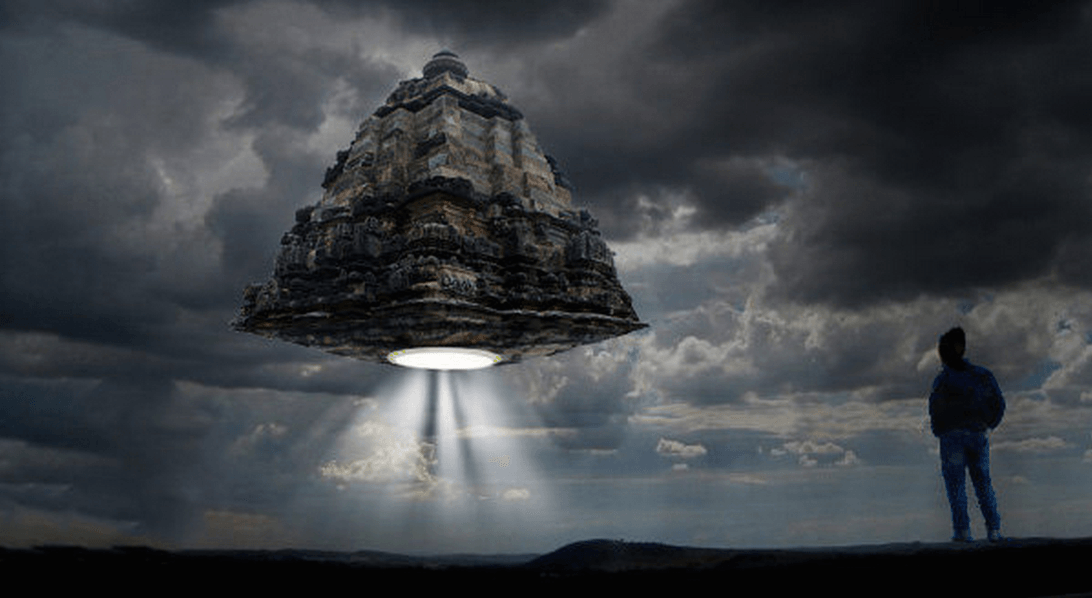
A Vimana is a word with several meanings ranging from temple or palace to mythological flying machines described in Sanskrit texts like Yajurveda, Mahabharata, Samarangana Sutradhara, Rigveda, Ramayana and even older ones. As well as being able to fly within Earth’s atmosphere, Vimanas were also said to be able to travel into space and travel under water.
Vimanas, of various shapes and sizes and with two or more engines, were sophisticated flying machines equipped with deadly weapons, and though they were used for ordinary travel and transports, their main purpose was warfare. Vimanas can fly at great heights with the aid of quicksilver and a great propulsive wind. These Vimanas could apparently travel vast distances and manoeuvre upwards, downwards and forwards.
Some Vimanas were saucer-shaped while others were cigar-shaped. The Vimanas – often described as shining flying cars, or celestial cars – were kept in a Vimana Griha, a type of hanger.
The Vedas, ancient Hindu poems, thought to be the oldest of all the Indian texts, describe Vimanas of various shapes and sizes: the Ahnihotra Vimana with two engines, the Elephant Vimana with more engines, and other types named after the kingfisher, ibis and other animals. According to Veda the Surya dev (God of Sun) and Indra (God of thunder) and several other Vedic deities are transported by flying wheeled chariots depicted to be pulled by animals, usually horses.
In 1975, Swami Dayananda Saraswati concluded, after having studied the Rig-Veda that flying machines did exist in ancient India. In his work entitled “Rigaveda Bhashya Bhumika”, he mentions aircraft in the Vedic mantras that:
is going from one island to another with these crafts in three days and nights… and just an intelligent people constructed ships to cross oceans… jumping into space speedily with a craft using fire and water… containing 12 stamghas (pillars), one wheel, three machines, 300 pivots, and 60 instruments…


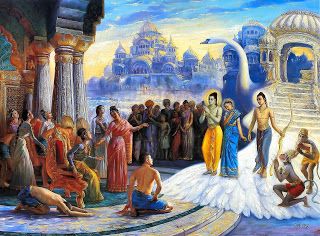
Lord Ram, Sita & Lakshman Reach Ayodhya on the Pushpak Viman

In the Ramayana we have descriptions of a special airplane called Pushpak Vimana. The plane originally belonged to Kubera, who was half brother of Ravana, the demon king and arch villain in the story of Ramayana. Pushpak Vimana was built by Vishwakarma (a celestial architect) under the orders of Brahma (God of Creation). The Pushpaka Vimana was a gigantic plane, of the size a large city entirely, capable of holding unlimited number of people.
Unfortunately, sometime later Ravana stole the ship from him and began using it for his own wicked ends. He used it to even kidnap and carry away Sita (Wife of King Rama) to his capital Lanka. He also used it in his war against Rama. After he was killed in the final battle, his brother Vibhishana, who succeeded him as king, suggested Rama to use the plane to go back home (Ayodhya) without losing further time.
The author of the epic gave a graphic description of the aerial view of the earth as the plane traveled over the subcontinent on its way to Ayodhya. The description was so accurate that according to some it correspond with the aerial view of the subcontinent form the outer space.
In the Mahavira of Bhavabhuti, a Jain text of the eighth century culled from older texts and traditions, we read:
An aerial chariot, the Pushpaka, conveys many people to the capital of Ayodhya. The sky is full of stupendous flying-machines, dark as night, but picked out by lights with a yellowish glare
It is evident that ancient Indians flew around in these Vimana, all over Asia, to Atlantis presumably; and even, apparently, to South America. Writings found at Mohenjo-daro in Pakistan is uncannily similar to the Writing found on Easter Island, called Rongo-Rongo writing.
In the Mahabharatra, an individual named Asura Maya had a Vimana measuring twelve cubits in circumference, with four strong wheels.
The Mahabharata also mentions the use of flying chariots powered by lightening, capable of flying long distances into the solar system and beyond. There are descriptions of a king Salva using a flying machine to attack Dwaraka and how Lord Krishna fought with him and destroyed the flying machine.
Interestingly in the Mahabharata we also find information about the terrible weapons belonging to the ancient Indian Gods that, in the light of our present day knowledge, do sound uncannily like nuclear weapons.
In the epic Srimad Bhagavatham (sixth Canto, Part 3) we come across the following reference:
One time while King Citaketu was traveling in outer space on a brilliantly effulgent airplane given to him by Lord Vishnu, he saw Lord Shiva… The arrows released by Lord Shiva appeared like fiery beams emanating from the sun globe and covered the three residential airplanes, which could then no longer be seen.Another work called the Samarangana Sutradhara contains 230 stanzas that are devoted to flight. It describes in detail, every possible aspect of flying. The International Academy off Sanskrit Research in Mysore, India, conducted a study of this ancient texts and published its findings in a book called ‘Aeronautics, a manuscript From the Prehistoric Past’. The following are a few translated excerpts from the text:
The aircraft which can go by its own force like a bird – on the earth or water or through the air – is called a Vimana. That which can travel in the sky from place to place is called a Vimana by the sage of old.
The body must be strong and durable and built of a light wood [Lagha-daru], shaped like a bird in flight with wings outstretched [mahavinhanga]. Within it must be placed the mercury engine, with its heating apparatus made of iron underneath.
In the larger craft [Daru-vimana], because it is built heavier, [alaghu], four strong containers of mercury must be built into the interior. When these are heated by controlled fire from the iron containers, the Vimana possesses thunder power through the mercury. The iron engine must have properly welded joints to be filled with mercury, and when the fire is conducted to the upper parts, it develops power with the roar of a lion. By means of the energy latent in mercury, the driving whirlwind is set in motion, and the traveller sitting inside the Vimana may travel in the air, to such a distance as to look like a pearl in the sky.


Ancient Indian Vimana
Four Diffrent types of Vimanas

In 1875, the Vaimanika Shastra, an ancient Indian text written by Sage Bharadvaja, using even older texts as his source, was rediscovered in a temple in India. It dealt with the operation of Vimanas and included information on the steering, precautions for long flights, protection of the airships from storms and lightening and how to switch the drive to “solar energy” from a free energy source which sounds like “anti-gravity.”
Later in 1895 Shivkur Bapuji Talpade, a Hindu scientist attempted to construct a flying machine – called Marutshakha – based on an ancient text’s instructions, which traveled 1800 feet before crashing to earth.
Vaimanika Shastra was rewritten by Pandit Subbaraya Shastry (1866–1940), who dictated it during the years 1918–1923. It contains 3000 shlokas in 8 chapters which Shastry claimed was psychically delivered to him by the ancient Hindu sage Bharadvaja. According to the Vaimānika Shāstra, the Vimanas of the ancient texts were actually true aerodynamic flying machines. Text contain details of the construction of these unbreakable machines, as well as a number of secrets, such as turning the machines invisible, making them motionless, and performing supernatural abilities like causing your enemies to lose consciousness or photographing the insides of their planes. Text also describes in detail, the construction of what is called, the mercury vortex engine the forerunner of the ion engines being made today. The text was translated to Hindi in 1959, and later to English in 1973.Sixth book written by Nine Unknow men, a secret society founded by Emperor Ashoka, contain secret of Gravitaion. This book, known to historians, but not actually seen by them dealt chiefly with “gravity control.” It is presumably still around somewhere, kept in a secret library in India, Tibet or elsewhere (perhaps even in North America somewhere). Ashoka kept work secret because he was afraid that the advanced science catalogued by these men, would be used for the evil purpose of war. The “Nine Unknown Men” wrote a total of nine books, presumably one each.
It is claimed that a few years ago, the Chinese discovered some Sanskrit documents in Lhasa, Tibet and sent them to the University of Chandrigarh to be translated. Dr. Ruth Reyna of the University said recently that the documents contain directions for building interstellar spaceships!
A few years ago, reports surfaced on the Internet of a Vimana discovered by the United States military in a cave somewhere in Afghanistan. As incredible as that, itself, sounds, the Vimana was also allegedly encased in a “time well,” leading to the disappearance of at least eight soldiers who attempted to retrieve it.
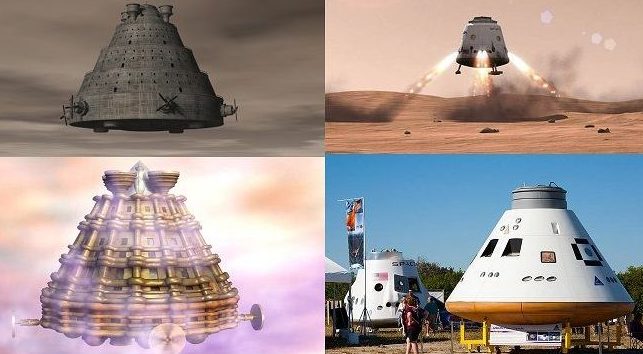
Many think they were talking about ancient UFOs, others say is pure myth. Still, not only these are precise descriptions, of machines, but one can also find an astonishing resemblance in the new NASA vehicle , Dragon, launched by SpaceX.

Nasa's Spacecraft copied from Ancient Indian Vimana
Nasa’s Spacecraft Dragon copied from Ancient Indian Vimana?